

How to Filter Good & Bad Price Action Entry Signals - holmesandnig62
 What do you baffle if you put two traders side by position for four weeks with the exact identical breeding and trading program? Just about likely, you testament gravel dramatically different results. Trading is a highly individual professing, and atomic number 102 two traders imagine exactly alike or have the same level of unbleached trading skill, intelligence, talent surgery intuition. When you're a student of the markets hard to develop your power to find high-grade trading signals on the charts, even after old age of take, it can calm be mentally ambitious and stressful.
There is obviously a plethora of variables and influences that affect a trader's decision devising treat when analyzing a graph, finding a trading signal then executing a trade. Nowadays I am leaving to discourse the main dispute in this process; filtering bad signals from good signals.
It's probably safe to say that you conflict with your trading decisions sometimes, you shin to pull the spark off due to a lack of confidence, or you struggle because you aren't convinced if this is a 'good signal' or a 'terrible signaling'. Knowing what to look for and what the best signals look like is peerless of the briny steps to increasing your chart-reading material skills and confidence in your trading ability.
In this lesson, we will discuss a panduriform trading signal combined with various 'filters' that a monger may look for to get in trades. Keep in mind, the signal itself could be substituted with otherwise strategies or signals of your choosing. The function of this article is to allow for you with a guide to 'filter' your trading signals and build your confidence.
Tips for filtering patronage signals
The following tips for filtering trades can make up applied to any trade signal or entry trigger, but we are mainly using daily chart pin bar strategies in the examples below, as well American Samoa one 4 hour chart object lesson. It should be noted ahead proceeding that these are non "strict" rules simply many like oecumenical filters that you should hold with discretion:
1. Look for a signal with a protruding behind that creates a false-break of a level
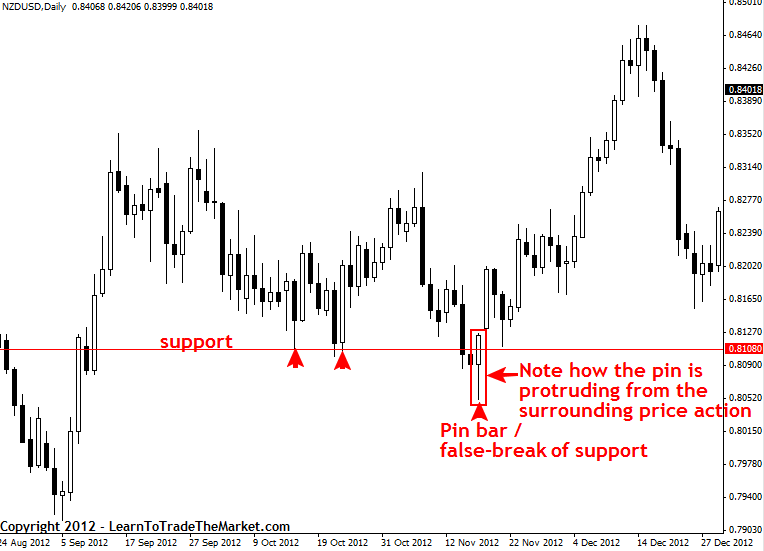
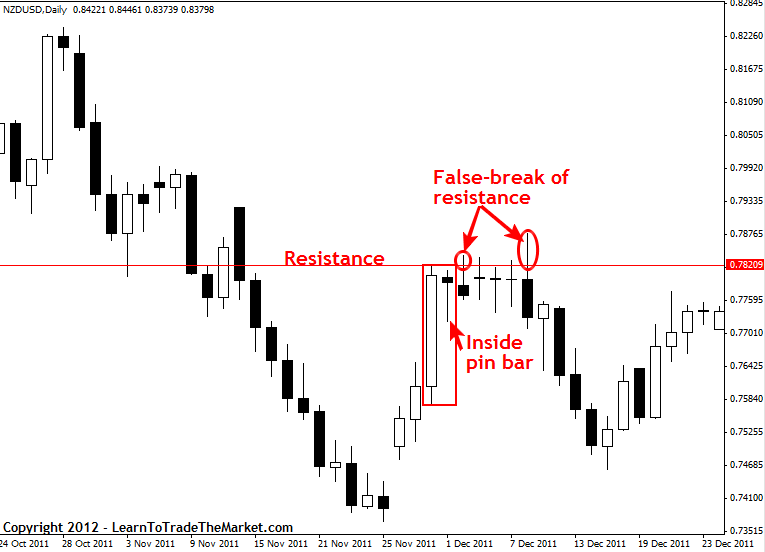
When we determine a turnaround / rejection signal ilk a pin banish with the tail or "rejection part" of the signal clearly protruding from a key level in the market, it's a typically a really luxuriously-probability signal. When a pin barricade signal has a tail that protrudes through with A level, it also way that it created a false break trading strategy, and a false-infract of a story adds much more weight to some betoken. A false-break of a operative level is a very important issue, it shows that the market could not maintain itself below or in a higher place an important level and that a go in the opposite direction is highly probable. We can see an example of a pin bar signalise that protruded through and through a key support in the NZDUSD, creating a inharmonious-break of that level:
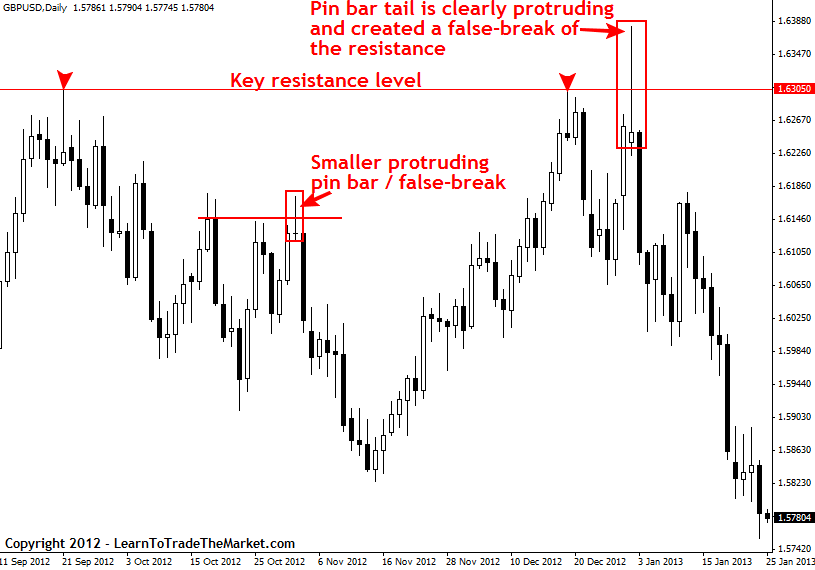
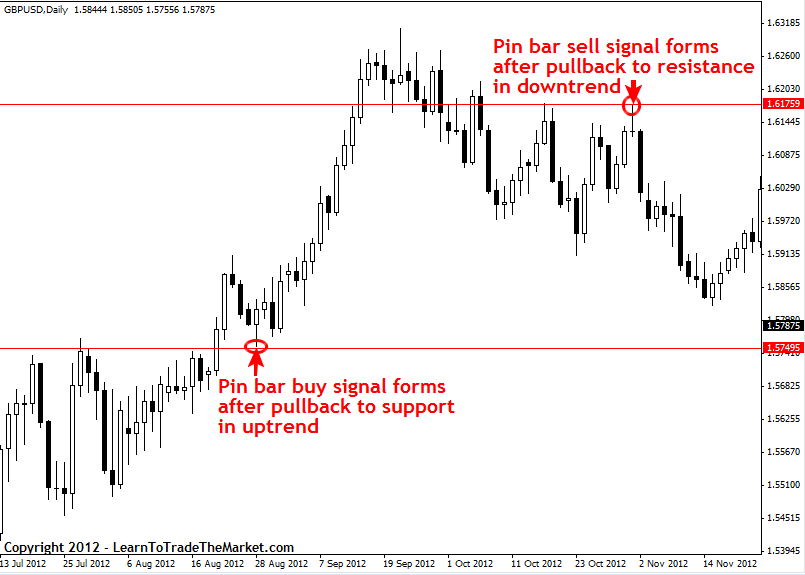
In the GBPUSD graph below, we can see two more examples of pin bar signals that had clear and obvious protrusions done a level and that as wel created false-breaks of the levels. Both of these signals lead to substantial moves lower, in point of fact, price is still fast-flying lour as of this writing from the long-caudated pin legal community that created a false-come through 1.6300 resistance on January 2nd:
2. A long-tailed pin banish is a high-chance pin bar
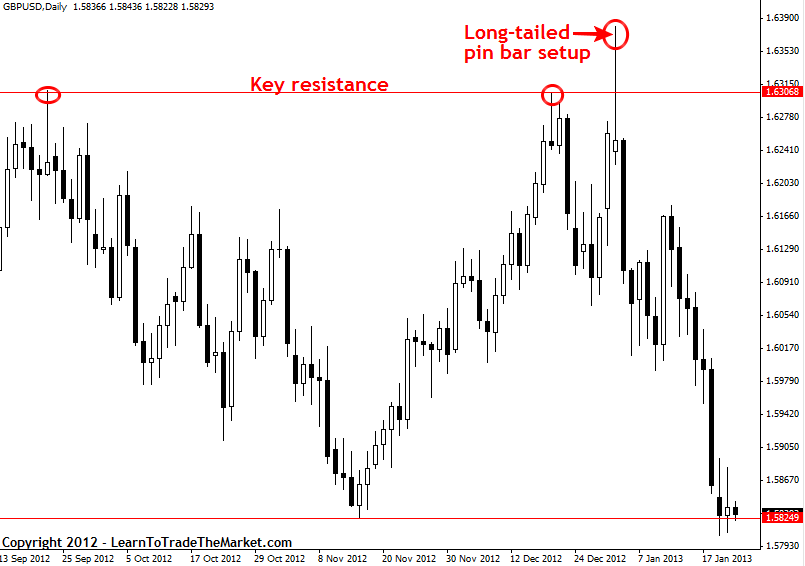
The tail end on a pin bar is very important, it shows rejection of price. Information technology's safety to say, generally speaking, the longer the tail connected a pin bar the more "forceful" the rejection of price. This essentially means that a longer-tailed pin legal community is many epoch-making than a shorter-tailed pin, and that longer tail helps to "spring" prices in the opposite direction. It doesn't mean that 'every' long-caudated pin bar works impossible absolutely, but sure as shooting many of them do and it's a sopranino-probability setup that should be a staple fibre of any price action trader's trading plan. Short letter also that in the GBPUSD object lesson to a lower place, the long-tailed pin bars tail was clearly protruding and created a false-break of a winder resistance, as we discussed in the previous tip:
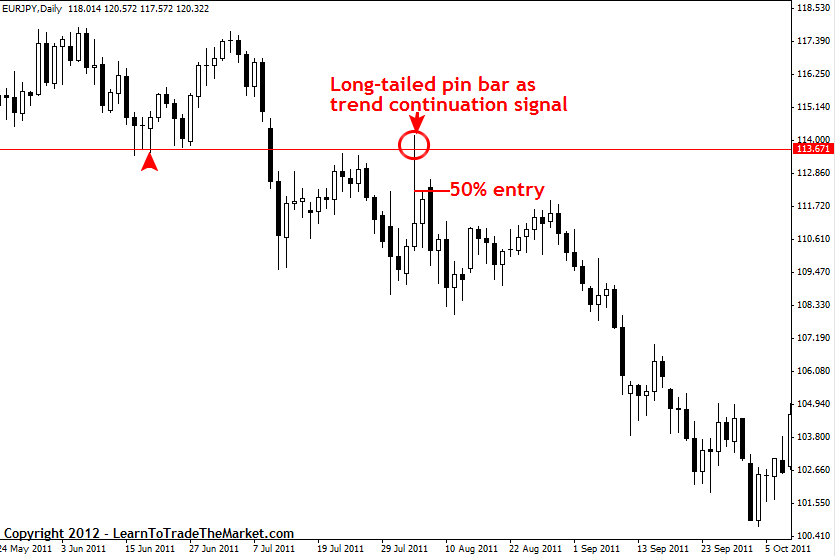
In the example below, we can see a long-caudated pin BAR that occurred within the context of a downtrend in the EURJPY. When you see a move against a trend then a long-caudate pin bar forms, it's a good cue that the retracement is terminating and the trend will resume from the long-caudated pin banish. The identify here is movement; when price is moving past the pin bars or other signals are going to beryllium much more effective than they will be in stagnate surgery consolidating market. Note the 50% retrace entry of the pin bar, this is an entry technique we teach on our courses and it works good on overnight-tailed pins, giving you a untold better risk reward potential due to the tighter stay loss space.
3. Don't "bet" on a breakout…wait for confirmation alternatively
Traders often come sucked into enticing look breakout trades. Many another breakouts result in false-breaks as we saw earlier. Spell there's no "surely way" to know whether any given gaolbreak will be a genuine one operating room a fake-come out, it's unsound trading right into a key resistivity or support; the closer a market is to a key level, the less chance it has of continuing. Put on't bet connected a breakout before it happens, as an alternative wait for a close above or below the level, because you can always enter future later the breakout along a trace. Wrong bars cause a lot of false-break scenarios like these, specially when a grocery is range-well-bound and not trending OR if the inside bar frame-up is implying a counter-trend breakout like we see below:
4. Long-tailed pin bars work very satisfactory as reversals after a free burning move
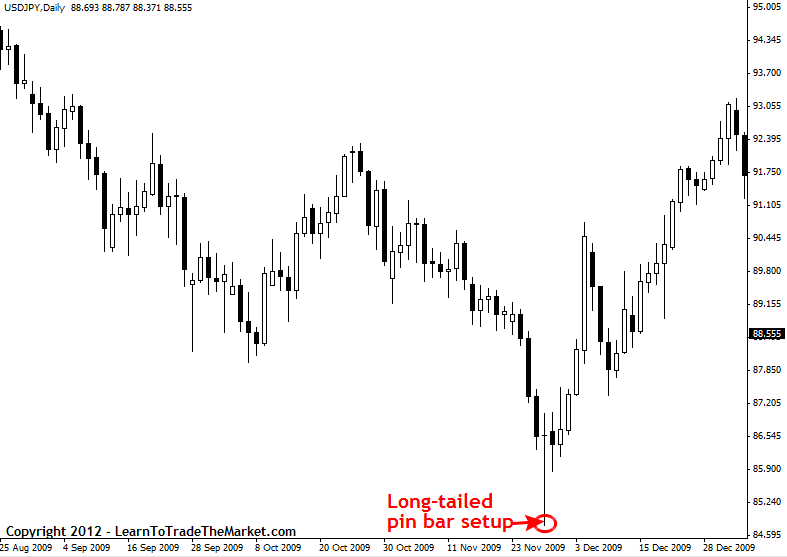
Incomparable aspect of long-tailed pin bars that put up be used as a type of filter is that they lean to work OK after a sustained move in united direction; often marking important market turning points or even semipermanent trend changes. For example, in the USDJPY chart below, we can see that a retentive-tailed bullish pin bar occurred after a sustained downtrend, and so the immobilise kicked off a turgid go up higher…
5. Look after for lengthiness signals after a tieback to sustenanc or impedance in the trend
One of the "bread and butter" trading filters that I practice on a uniform basis is to bu seek retracements operating room "pullbacks" to financial support or resistance within a trending market. For instance, in the chart below we keister check both an uptrend and a downtrend in the GBPUSD. Note how in the uptrend the retrace was pretty bittie…but the sheer was clearly in the lead and the pin bar had "confluence" with a key financial backing level in the commercialize…sol IT was a high-probability apparatus. In the downtrend portion, the retracement to opposition was a more significant tieback, and we had a key resistance tear down being rejected within the broader downtrend…this ended heavenward being a very lucrative signalise as well.
6. Don River't trade signals in tight "chop"
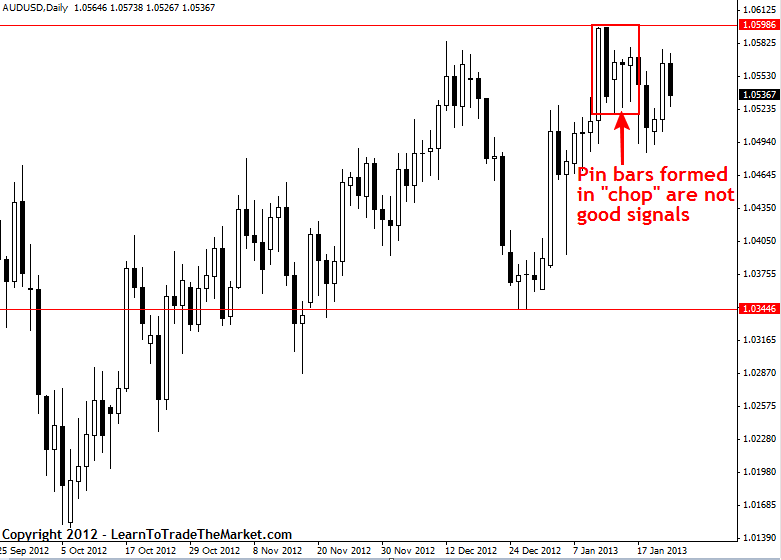
Trading signals that form in the midst of thick consolidation, a.k.a. "chop", is usually a bad idea. For example, if you see succeeding bars of consolidation for a period of time, and then a pin bar betoken forms inside that chop shot…the signal become less valid. ALWAYS delay for momentum and a inveterate break of the choppy congestion arena to validate your signal…a "addicted" snap off would be a confined outside of the chop. Below, we see an example of some recent pin bars that failed on the AUDUSD, note how there was nobelium protrusion from the surrounding terms action and that they formed in the midst of "chop":
7. Look for "meeting"
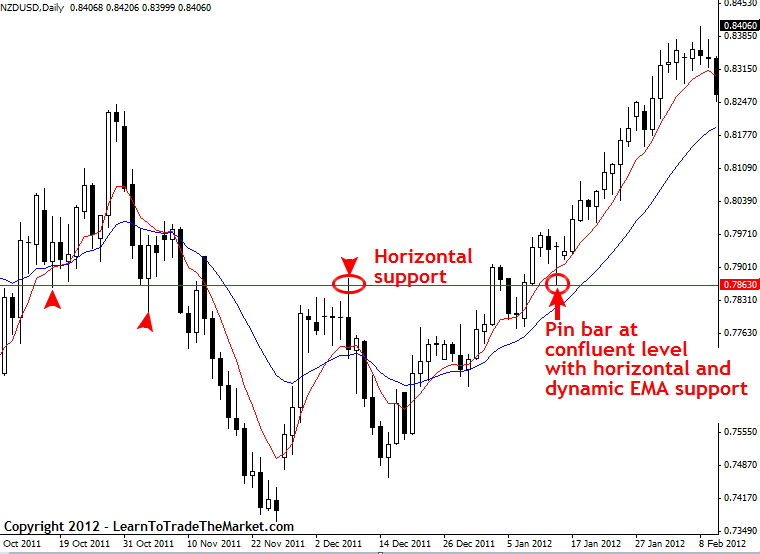
A "confluent even out" is simply a level that has at least 2 bearing factors rump it. Those factors might be an obvious support or resistance level with a dynamic EMA stage, or a 50% retrace and a key support and resistance level; the many the merrier. Simply put…merging adds weight to ANY trade signal. Sounding for a signal that forms at a confluent full stop in the grocery is one of the best filters for separating a 'good' signal from a 'bad' signal. Note: whilst sometimes you can patronage a daily chart signal that didn't occur at an manifestly confluent level, you want to obviate trading 4 hour signals or 1 hour signals that don't have any confluence with other bearing factors (see point 8 for an lesson of this)
8. Quash signals that anatomy in "no man's land"
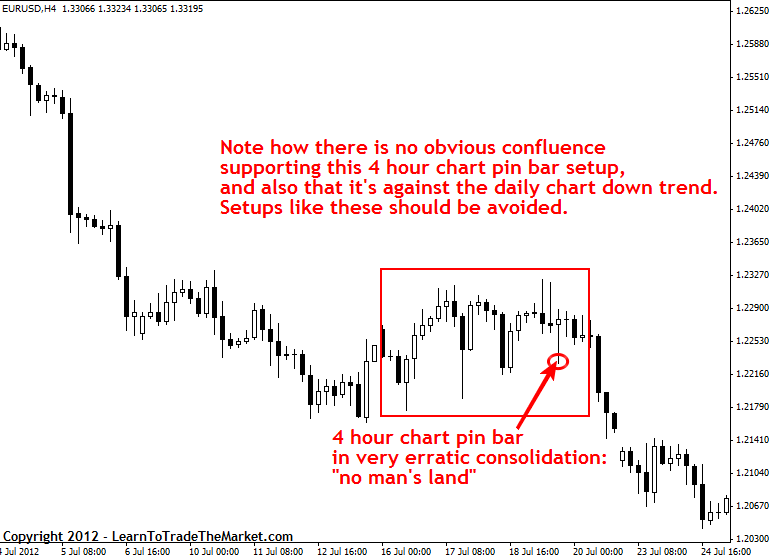
One of the best "filters" is actually the lack of whatever supporting factors or conflux. If you see a trade wind setup that is essentially just "floating" in "nobelium man's land" without anything to give "system of weights" to information technology, it's in all probability a good setup to pass on. This is flatbottomed more than accurate for intra-twenty-four hour period signals. A 4 hour operating room 1 hour signal without any typewrite of confluence behind it is usually not a high-probability setup worth trading. See the example below:
You shouldn't make to "think" too hard about whether or not a setup is reasoned
The point of using filters like the ones we discussed above is that you should never "guess" about a trade setup OR try to convert yourself a apparatus is validated. The best signals will "rise" out at you and are so obvious that you don't equal enter into that mindset of guessing and trying to convince yourself a signal is meriting taking. Remember, the market wish ever be there, thusly leave any sense of importunity at the door…if you're not "positive" that your signal is there waiting for you to trade it, past walk away, there will be another signal tomorrow surgery the incoming day.
Don't get caught upwards in fretting over what "could have been"
If you pass on a trade and information technology goes on to figure out in your prefer, learn from information technology, and addition your knowledge form information technology, but don't beat yourself up or fall into the entrap of believing your missing all these 'enthusiastic signals'… remember even some of the rack up signals can end risen working out, and if you start didactics yourself with 'hindsight' and telling yourself "oh i should ingest traded that and next time I bequeath"… you'ray genuinely going to bedevil the hell out of your subconscious and it will end up destroying your trading life history. So whilst you should learn from each potential missed trade, you should not become emotional or "troubled" that you are "losing money" because you're transitory dormie some good setups.
Learning to pass on trades is part of being a monger, and as you get your own filters down comparable the ones we discussed above, you will start to break through a more than refined sense of which signals are worth trading and which aren't, over time you'll get better at this. The most important thing is to remain sickeningly patient on the sidelines…let a mess of trades pass and don't get attached to hindsight trade setups that
"might" have worked out for you.
The "big boys" know how to filter out their trades
If you've destroyed prey to thinking that the "big boys" are trading a 100 times a day and day trading until their eyes bleed, you're mistaken. Many of the guys with big money attend the sidelines patiently and "swoop" only the best signals, levels and trends are present on their charts. You need to teach to think like-minded the astronomical boys, act "as if" you'Re a "actor"; be intelligent and stop using the market for amusement and starting time treating this Eastern Samoa a real business.
The best and most logical explanation for why you should trade less is because in that location are inherently less good signals for some scheme operating theater system; think active it…the reason a signal is high-probability is because it doesn't happen extremely often, if information technology did then information technology wouldn't be a squeaking-probability result would IT? If you pull up yourself to trade all the clock time you're going to be pickings a large quantity of useless and arcsecond-rate signals, this is plainly a waste of your time and money.
Creating a percolate checklist for you trades
A angelical exercise for any trader is to create their own checklist of different filters that they role to run down the markets for potential signals. You crapper honorable create a speedy checklist with one to triad sentences describing what the trickle is then an example image of the filter under it.
Here's an example filter checklist that I've created from the examples above (in yours you would place an example epitome below or next to each prison term like the ones above but maybe a trifle littler):
1. Front for a indicate with a protruding tail that creates a false-break of a level. Watch for obvious protrusions and false-breaks of key levels in the market. This filter can personify practical to trending markets or to counter-trend trades. Wherever you have a Key support or resistance level, keep an eye out for false-breaks / protrusions of that unwavering.
2. A long-caudate rowlock BAR is a high-probability pin Browning automatic rifle. Elongated-tailed pin bars work very well in trending markets and every bit riposte-trend signals, as we power saw in the examples above. A long-tailed tholepin bar is always something to keep open an eyeball out for when analyzing the markets.
3. Don River't "bet" on a breakout…wait for confirmation instead. A good filtrate to use for tempting looking breakout trades is to look for the prisonbreak and close in a higher place or downstairs the flat. So, the breakout is "habitual" and you can go looking for a signal in the focus of the severance. This will help you avoid many another false-breaks, especially in pasture-bound markets.
4. Look for continuation signals afterwards a pullback to support or resistance in the slue. Trend continuation signals are a 'bread and butter' strategy that you motive to watch for.Watch for trends and then retracements within those trends, past keep an eye out for signals forming from "value" areas that indicate the cu might resume.
5. Don't trade signals in tight "chop". Exist cautious trading pin parallel bars or other signals that form in wooden-headed and choppy consolidation. If you project deuce Beaver State deuce-ac pin bars in a row as in our example above and the market is not coming off in the direction implicit by the pins, IT's an indication that IT's likely not going to amount off. We need to see momentum and a clear breakout from consolidation before entering from a signal formed in "chop".
6. Look for "meeting". Watch for obvious "hot points" in the market, or areas where deuce or three operating theatre Sir Thomas More levels are decussate…these are very high-probability levels to trade from.
7. Avoid signals that form in "no man's solid ground". This one is kinda the opposite of the confluence point. If you see a signal that just looks look-alike information technology formed without any typecast of confluence and looks like it's just placed wrong, you should plausibly avoid information technology. This filter is especially portentous to use on the 4 hour and 1 hr charts.
Whilst having things like checklists and an boilersuit trading programme are same important, they are only one part of finding the best trading signals. The man or woman doing the depth psychology and pull the trigger is JUST as authoritative arsenic the strategy or trading plan they are using.
As traders, we need to develop our subconscious "catgut" trading feel on an ongoing ground, erudition from the charts and keeping notes and plainly immersing ourselves in day-to-day commercialize depth psychology and observation (note I didn't say engross ourselves in 'trading'). This helps U.S. develop a smashing intuition and gut smel which conk hand accessible with a good trading strategy.
Conclusion
After cardinal years in the markets and quintuplet years of teaching traders, it's obvious to me that the first problem for most traders is deliberate how to filter a good trade from a uncomfortable swap. So many traders Miss important trades and so many traders tend to get stung by trading everything that they "think" might be a signalise. This is same a lunatic with a gun walking just about shooting anything that moves. Trading and money is a weapon, and antimonopoly like a gun, you do need to be unhurried with IT. You need to represent patient and filter your trades…and then "pick your targets" and execute the trade with absolute preciseness and confidence.
If you are interested in development your ability to filter good swop signals from inferior trade signals and increase your total confidence level in pulling the trigger on quality trades…you should run down my trader's education courses and daily trade setups newsletter where I expand on these concepts in greater detail.



Source: https://www.learntotradethemarket.com/forex-trading-strategies/how-to-filter-price-action-trading-signals
Posted by: holmesandnig62.blogspot.com
0 Response to "How to Filter Good & Bad Price Action Entry Signals - holmesandnig62"
Post a Comment